

The Holy Scriptures of the Old and New Testament are the only infallible rule for Christian doctrine (2 Tim 3:16–17; 2 Pet 1:21). Everything we are to believe about God is found in the Scriptures. Yet, the Church’s understanding and articulation of what Scripture teaches has grown in clarity through the centuries.
When we look at historical theology, it is clear that one of the tools God uses to grow the Church’s understanding of doctrine is false teaching. The existence of false doctrine provokes refutation (Titus 1:9). This drives God’s people back to His Word to crystallize their understanding (2 Tim 2:7). This does not create doctrine, but rather clarifies our understanding of doctrine that has always been present in Scripture.
The Arian Controversy
Arius was a presbyter in Alexandria during the early fourth century. Around 318 AD, he began teaching contrary to the bishop of Alexandria. He said things like, “If the Father begat the Son, he that was begotten had a beginning of existence: and from this it is evident, that there was a time when the Son was not.”
If Jesus was not eternal, Jesus was not God. The teaching of Arius struck at the very heart of Christianity. Both the doctrine of the Son and the doctrine of the Trinity were at stake. If Jesus was created, He was not God. If Jesus was not God, then God is not a Trinity.
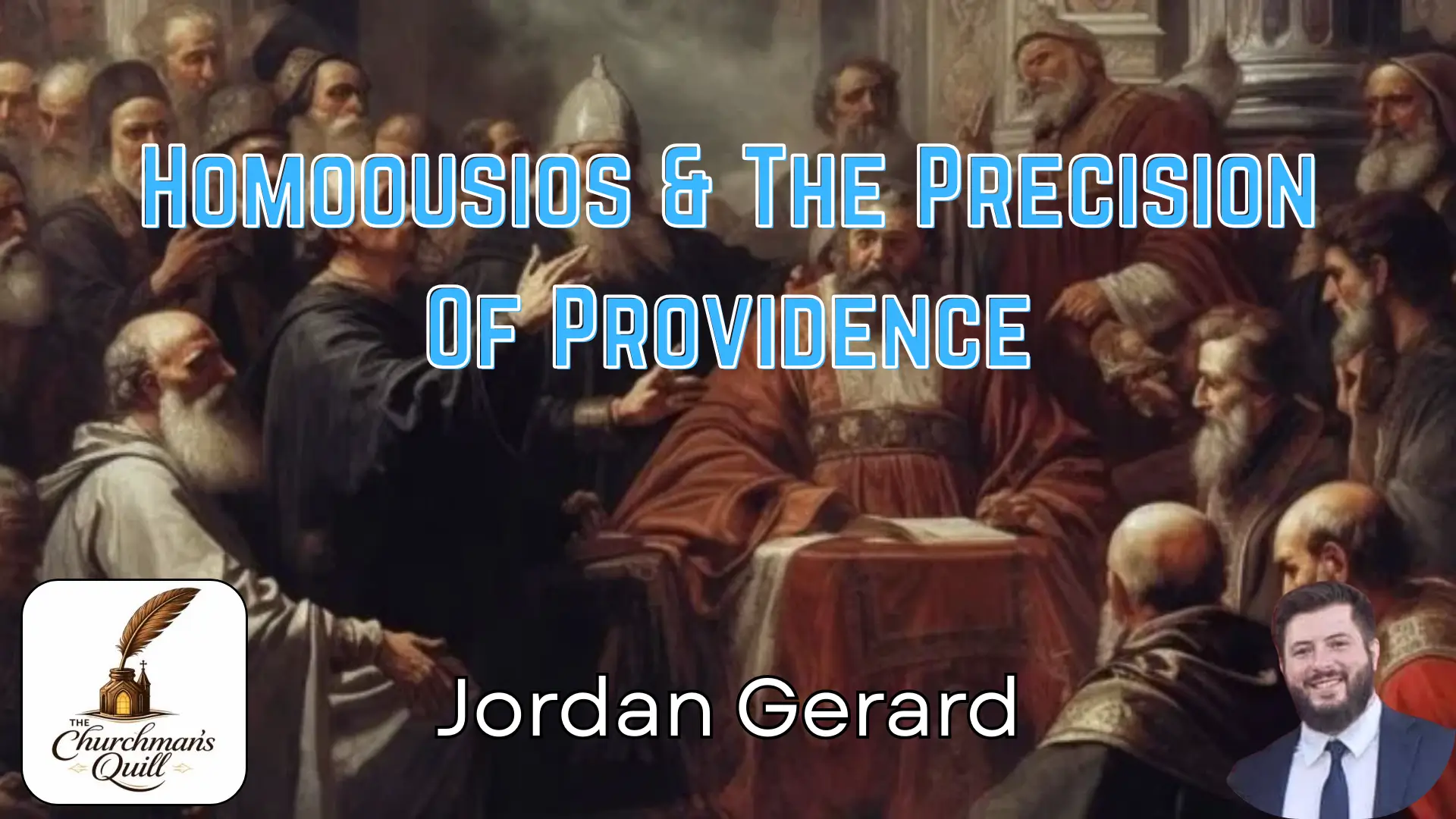
The Church needed to crystallize the teaching of Scripture. The dangerous Arian doctrine needed to be refuted. In 325 AD, the Church gathered to do just that. From all across the Roman Empire, over 300 bishops were summoned by Emperor Constantine to the city of Nicaea.
The First Council of Nicaea
One of the difficulties in refuting Arius was that he would claim to believe in all of the Scriptures used to correct him. Affirming the wording at face value, Arius would deny the meaning and implications of the Scriptures. This created the need to use very specific language to define the beliefs on both sides.
The false teaching of Arius is summarized in the word heteroousios (ἑτεροουσιος). This is formed from two Greek words héteros (“another, different”) and ousía (“nature, being”). According to Arius, Jesus is of a different nature than the Father.
On the other hand, the bishops put forward the biblical doctrine summarized in the word homoousios (ὁμοούσιος). This is formed from the two Greek words homós (“same”) and ousía (“nature, being”). Jesus is of the same nature as the Father.
The Arian controversy was argued on the basis of one word: Jesus is of one substance with the Father. The Nicene Creed, that we still recite today, contains this very truth that refuted this Arian doctrine:
“We believe…in one Lord Jesus Christ, the only Son of God, begotten from the Father before all ages, God from God, Light from Light, true God from true God,
begotten, not made; of the same essence as the Father…”
The Precision of Providence
This is not meant to be a thorough examination of the council. Nor are we considering the ongoing debate that would continue after the council. The point I want to make is simple. God works out His providence down to the very last detail. Even in something as central as the nature of the Lord Jesus Christ, we see God working with precision—down to a single word.
He is Lord over all things. Over the expanse of the universe down to the last molecule, God is in control. Not only did He create the sea (Ps 95:5), but He also tells its waves precisely where to stop (Job 38:11). Not only did He create the heavens (Neh 9:6), but He also knows every star by name (Is 40:26).
The providence of God is vast, because it encompasses all of creation. Yet, it is precise, because it consists of every last detail that comes to pass.
God kept His Church from the Arian heresy by means of a single word. The same God orchestrates all things that come to pass in our lives. May we all take comfort in that.
“A firm faith in the universal providence of God is the solution of all earthly troubles.” – B.B. Warfield
The God who preserved His Church through the careful use of a single word continues to govern every detail of our lives for our good and His glory.
Further Reading
The following resources are excellent for deepening your understanding of the council of Nicaea, the Arian controversy, and the doctrine of providence:
2,000 Years of Christ’s Power Vol. 1: The Age of the Early Church – Nick Needham
The Arian Controversy: Second Edition – Henry M. Gwatkin
What is Providence? – Derek W. H. Thomas