
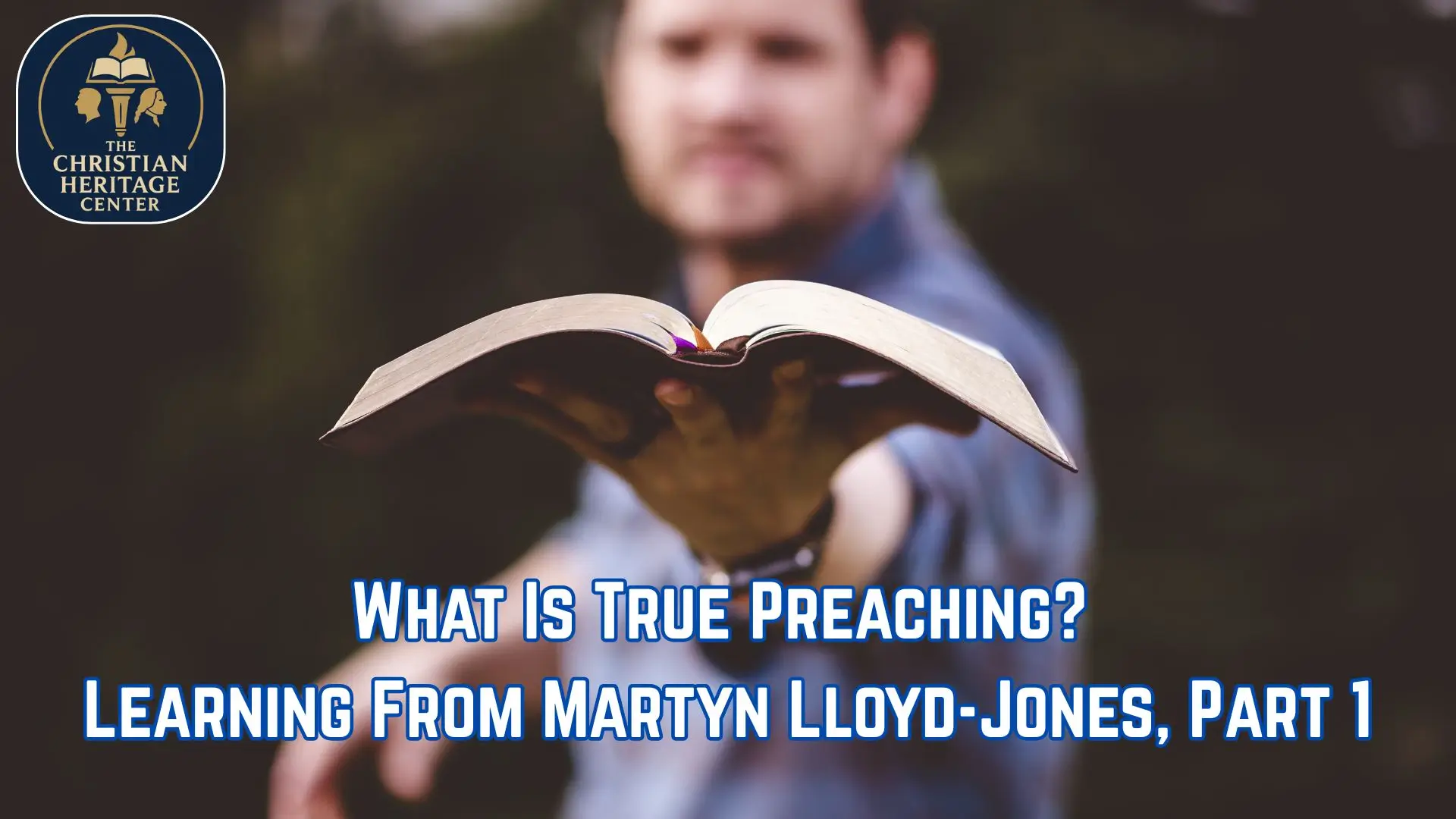

Martyn Lloyd-Jones characterizes “true preaching” in the following way:
“It is certainly not a matter of rules or regulation, and much of the trouble, I think, arises because people do regard it as a matter of instructions and rules and regulations, of dos and don’ts. It is not that. The difficulty is that of actually putting our definition into words. Preaching is something that one recognizes when one hears it. So, the best we can do is say certain things about it, that it is this, and not that.”[1]
One thing Lloyd-Jones was particularly gifted at was speaking generally about a subject, and he was always clear when he was doing so. I say this to do the same. As I walk through the marks and characteristics of “true preaching,” these are being dealt with in a general sense, not definitively or exhaustively. Keep that in mind. Nonetheless, they hold true.
In Preaching and Preachers, chapter five, Lloyd-Jones begins to lecture on “The Act of Preaching.” He invariably connects this with “delivery”. We should clarify in our minds what he is addressing here. He is not speaking about preparation or sermon content, but about the actual delivery and communication of the sermon. Also, it is meant to distinguish preaching from teaching and lecturing as well.
In this chapter, he provides a list of several aspects, qualities, elements, or characteristics of true preaching. In a very real sense, these characteristics lie at the very heart of what “true preaching” is and what it is not.
True Preaching Involves the Whole Personality
Lloyd-Jones states, “The whole personality of the preacher must be involved.”[2] He goes on to explain that it is not merely the personality that must be engaged, but the whole man, his body, physicality, and presence as well.
True preaching is not simply words communicated, nor is it an unfelt, unmoved delivery. God has created each minister uniquely; therefore, God has designed it so that every preacher preaches differently. Yet He requires that every preacher involve the whole of his person, his being, personality, and presence.
The eternal realities with which the minister deals are of such weight, and he has been so affected and moved by them, that he must communicate them with his whole being, not merely with his words. Every part of him preaches. His face pleads. His hands invite. His speech persuades. His very being summons his hearers. True preaching necessitates the whole man.
True Preaching Is Marked by a Sense of Authority
Lloyd-Jones says, “I would emphasise…a sense of authority and control over the congregation and the proceedings.”[3] He seems to put this forward in a two-fold sense.
First, there is the sense that the preacher himself is under divine authority, that he has been divinely commissioned to this task. Second, this manifests itself outwardly in authority over his hearers and in the divine right to perform his calling.
I believe Lloyd-Jones would closely link this to the importance and significance of being called to the ministry. For him, the two go hand in hand. He immediately distinguishes this sense of authority from self-confidence, which he called “deplorable.”[4]
True preaching conveys authority to the congregation, and there are inevitable implications that follow. Chief among them is this: it is never appropriate to apologize for preaching the Word of God. The preacher is not present at the behest or pleasure of the people, but based on being a divinely commissioned ambassador.
When a person encounters true preaching, they come under a sense of authority. They do not leave with the impression that the preacher has offered suggestions, recommendations, or conceptions, but rather declarations and proclamations.
True Preaching Is Marked by Freedom Under the Spirit
Lloyd-Jones next expands on what he calls the “element of freedom.”[5] He treats two aspects here, freedom and what he terms “connection.” I have categorized these together under the heading of freedom under the Spirit.
Here, he emphasizes that true preaching always contains an element of spiritual freedom. The preacher must be free to speak in the moment as one under the power and influence of the Holy Spirit. The minister must not be overly bound to his preparatory thoughts and structure, nor should there be a rigidity that makes him reluctant to speak what comes to him in the moment.
As the preacher is free, he will also be open and receptive to the response of the congregation. In one sense, Lloyd-Jones is teaching that there are elements involved in true preaching that cannot, and will not, be prepared for because they are spiritual, spontaneous, and extemporaneous in nature.
He writes:
“This element of freedom is all-important. Preaching should be always under the Spirit, His power and control, and you do not know what is going to happen. So always be free. It may sound contradictory to say ‘prepare, and prepare carefully,’ and yet ‘be free.’ But there is no contradiction, as there is no contradiction when Paul says, ‘Work out your own salvation with fear and trembling, for it is God that worketh in you both to will and to do of his good pleasure’ (Phil. 2:12–13).”[6]
This is especially important in our own day. Yes, prepare. Yes, bring your notes, and even your manuscript if necessary, but you must not be dogmatically tied to or bound by them.
In part due to much unorthodox teaching on the Spirit of God, many good brothers have become overly cautious and, at times, forgetful that the Spirit of God works both in preparation and in the act of preaching. We must be open to and expectant of both if we are truly to preach the Word of God.
True Preaching Is Marked by Seriousness Without Dullness
Lloyd-Jones opens this section by stating, “The preacher must be a serious man; he must never give the impression that preaching is something light or superficial or trivial.”[7]
This seriousness flows from the very nature of what the man in the pulpit is doing. He is dealing with matters of life and death, eternal realities. He is handling never-dying souls. For Lloyd-Jones, this demands seriousness as the only appropriate attitude in preaching.
However, to guard against seriousness degenerating into sadness, morbidity, heaviness, or dullness, Lloyd-Jones balances seriousness with liveliness. He says, “The preacher must be lively; and you can be lively and serious at the same time.”[8]
Once again, this is a much-needed reminder for our day. Preaching, by virtue of its content and nature, must never be boring or uninteresting. It should be marked by seriousness, energy, enthusiasm, and vitality. True preaching requires life in its delivery, not complacency or lethargy. One leads to transformation, the other leads to sleep and inattentiveness.
Conclusion
Thus far, we have seen that true preaching, in a general sense, involves the whole personality of the preacher, carries with it a sense of authority, demands freedom under the Spirit, and must be marked by seriousness without dullness. Consider how different true preaching, as described by Lloyd-Jones, is from much of what we witness and experience today. We must also consider our own failures and deficiencies in preaching. I praise God that He honors His Word even when it is delivered in a dull, lifeless, trivialized, or even misguided manner. He is faithful to work through His Word for the sake of His people, even when it is not accompanied by true “preaching.” Yet this does not mean that we should abandon the pursuit of greater usefulness and greater blessing. Rather, it should drive us to prayerfully strive to be more faithful and more biblical preachers, and to honestly examine our own preaching in light of what Lloyd-Jones characterizes as “true preaching.”
In the next article, we will consider how true preaching is further marked by zeal, warmth, urgency, persuasiveness, and power.
[1] Martyn Lloyd-Jones, Preaching and Preachers, 40th Anniversary Edition (Grand Rapids: Zondervan, 2011), 95.
[2] Lloyd-Jones, Preaching and Preachers, 96.
[3] Lloyd-Jones, Preaching and Preachers, 97.
[4] Lloyd-Jones, Preaching and Preachers, 97. Lloyd-Jones states, “Obviously this is not a matter of self-confidence; that is always deplorable in a preacher.” He then goes on to quote 1 Corinthians 2:3 which speaks of Paul’s conscious weakness and inadequacy for the task. The authority is not one a human inception or origin, it’s rooted in the divine commission, calling, and office God has given. MLJ speaks of divine authority.
[5] Lloyd-Jones, Preaching and Preachers, 97.
[6] Lloyd-Jones, Preaching and Preachers, 99.
[7] Lloyd-Jones, Preaching and Preachers, 99.
[8] Lloyd-Jones, Preaching and Preachers, 100.