
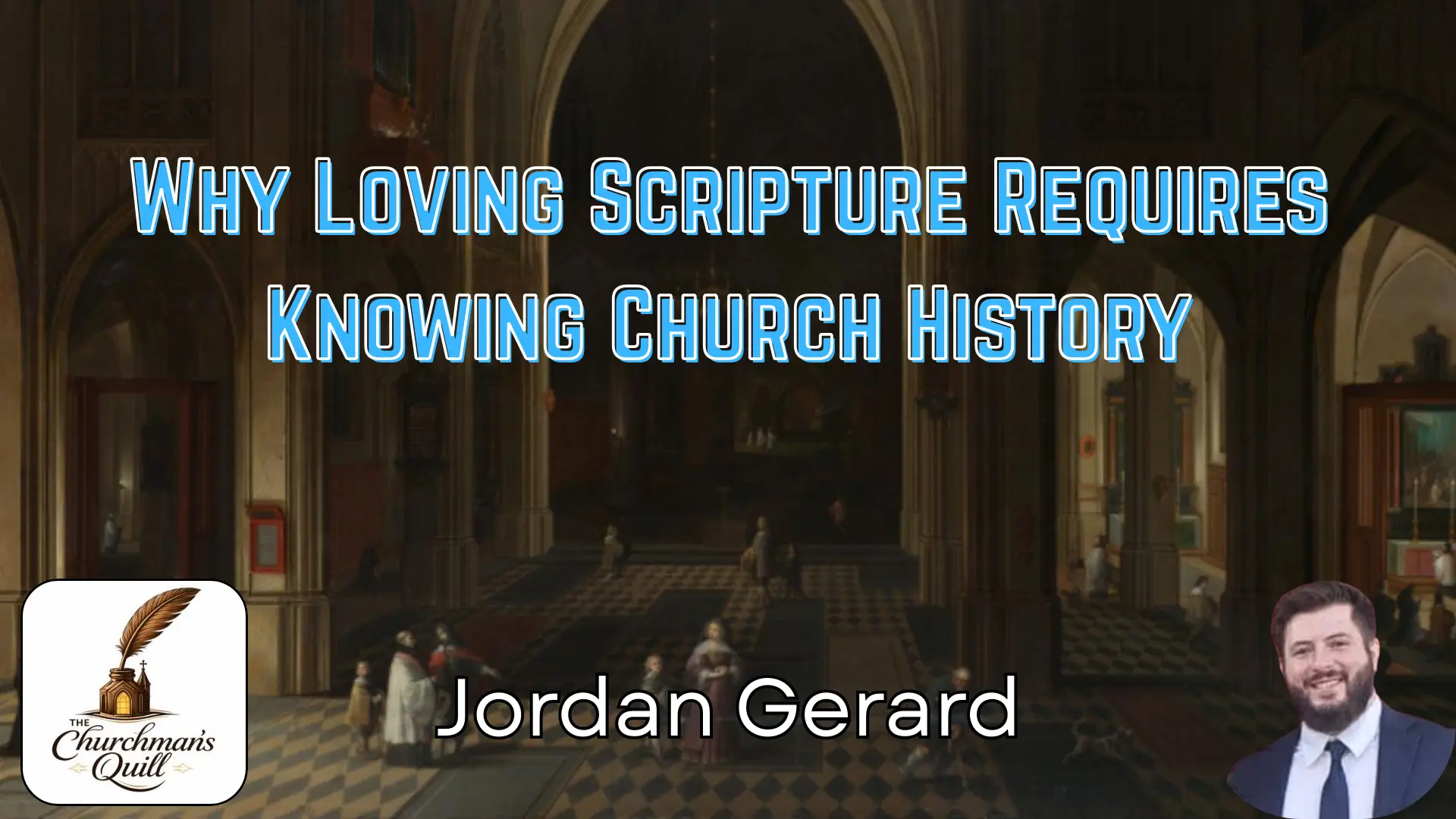

Some people have a natural interest in history. Digging deeply into past wars, empires, and ancient civilizations is an enjoyable pastime for them. For others, studying history may only be considered useful as a sleep aid. Most people would fall somewhere in the middle of this spectrum. Regardless of whether history is of natural interest to you, I am submitting that as Christians, we are called to know Church History.
The Nature of Scripture
When we zoom out and look at the Scriptures, we see that they are, in summary, a history of God’s people. Starting with creation and man’s subsequent fall, we see a historical unfolding of God’s plan of salvation. The flood, a lineage, famine, enslavement, deliverance, etc. These are all historical realities that are recorded in the Scriptures. The beauty of divine truth came through the homeliness of human history.
God is the author of all of history, but what we have in the Scriptures are certain portions of history that He chose to inscribe in His inspired word. The Scriptures are inspired by God, so they are indeed more than history, yet they are not less.
When we consider this fact in light of God’s immutability, we find our precedent for studying church history. God has promised to build His church (Matt. 16:18) and that He will be a God to His people (Ez. 36:28, Jer. 30:22, Gen. 17:7). We see this promise being carried out in the Scriptures, but what about afterward? Has God’s promises failed? By no means.
Since God cannot change (Mal. 3:6) and cannot lie (Heb. 6:18), we know that His promises will come to pass. And when we study church history, we study the continued covenantal care that God has promised to show to us. He has not stopped caring for His people, and we can see evidence of that recorded in church history.
The Example of Scripture
Again and again, the Scriptures say to remember history. Throughout the Psalms, we are told to remember what God has done (Ps. 77:11-12; 105:5; 145:5). The people of Israel were told to remember their deliverance from Egypt (Ex. 13:3, Deut. 8:2). Jesus Himself instituted the Lord’s Supper in remembrance of Him (Lk. 22:19). There is a principle of looking back found in the Scriptures.
In 1 Corinthians, Paul gives one reason we should look back. In speaking of the doubt and unbelief of the Israelites, he writes, “Now these things took place as examples for us, that we might not desire evil as they did. Do not be idolaters, as some of them were…” According to Paul, we look back at history to learn what not to do.
The opposite is true as well.
The author of the book of Hebrews uses history to point out positive examples as well. In speaking of examples of faith, he writes, “By faith Abel offered to God a more acceptable sacrifice than Cain…by faith Abraham obeyed when he was called to go out to a place that he was to receive as an inheritance…By faith Sarah herself received power to conceive…By faith Moses…By faith Rahab…” an on and on he goes. The point is that he is looking back at history to learn what to do.
The same is true of church history after the close of the canon. We can study church history to learn both what to do and what not to do. You will find inspiring accounts of bravery and Christlikeness, as well as drastic moral failures, all done by those naming the name of Christ. Much like how Paul and the author of Hebrews used inscripturated history to look back on and learn, we can with church history as well.
The Teaching of Scripture
In Colossians, we read, “let the word of Christ dwell in you richly, teaching and admonishing one another in all wisdom…” There is teaching and admonishing one another within the body of Christ. As the word of Christ dwells in us richly, we ought to teach and admonish others for their edification. This, being written in a letter to an individual church, clearly takes place primarily within a local congregation. But what is the principle?
The church of Jesus Christ is not limited to a single congregation. It is not limited to a single country. And most relevant to us right now, it is not limited to a single time period. Since we are commanded to teach one another, and we know that the Church isn’t limited to our time period, we can learn from those who have come before us. As a matter of fact, there is great wisdom in doing this. On one hand, the church before us has had its own struggles and blind spots. However, put positively, they are often free from our struggles and blind spots.
The book of Proverbs teaches us that there is wisdom in having a multitude of counsellors (Prov. 11:14; 15:22; 24:6). The idea is that with more counsellors, you will have more insight. However, the closer those counsellors are to each other, the smaller the range of their insight. I am submitting that we ought to find counsellors from the past. When we include those from different time periods, with different strengths and different weaknesses, we broaden the range of our counsel and thereby strengthen its safety.
Conclusion
In conclusion, the study of church history is not simply an academic exercise, but a vital aspect of faithful Christian living. By looking back at how God has worked in and through His people, we gain perspective, wisdom, and encouragement for our own walk with Christ. Church history reminds us that we are part of a much larger story—one that is guided by God Himself. As we learn from those who have come before us, both their successes and their failures, we become better equipped to serve, persevere, and grow in faith. Let us, therefore, approach church history with humility and gratitude, eager to glean all that God would teach us through His people across the ages.
Further Reading
The following resources are excellent for deepening your understanding of church history:
“Church History in Plain Language, Fifth Edition: The Story of the Church for Today’s Readers“ – Bruce Shelley
“History Of The Christian Church (The Complete Eight Volumes In One)” – Phillip Schaff
“Historical Theology: 2 Volume Set” – William Cunningham
“2000 Years of Christ’s Power” – Nick Needham
“ESV Church History Study Bible” – Edited by Stephen J. Nichols, Keith A. Mathison, Gerald Bray, and Michael Reeves.